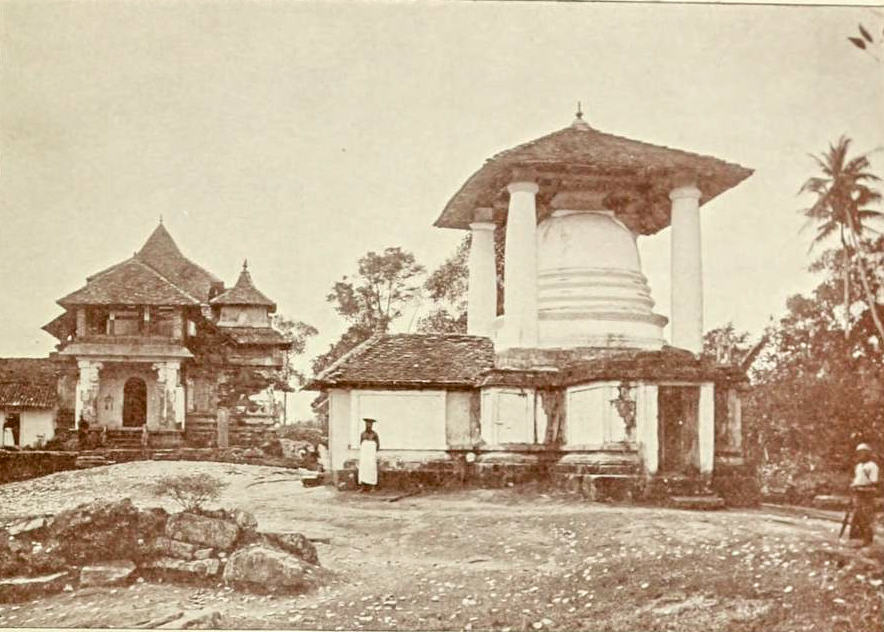
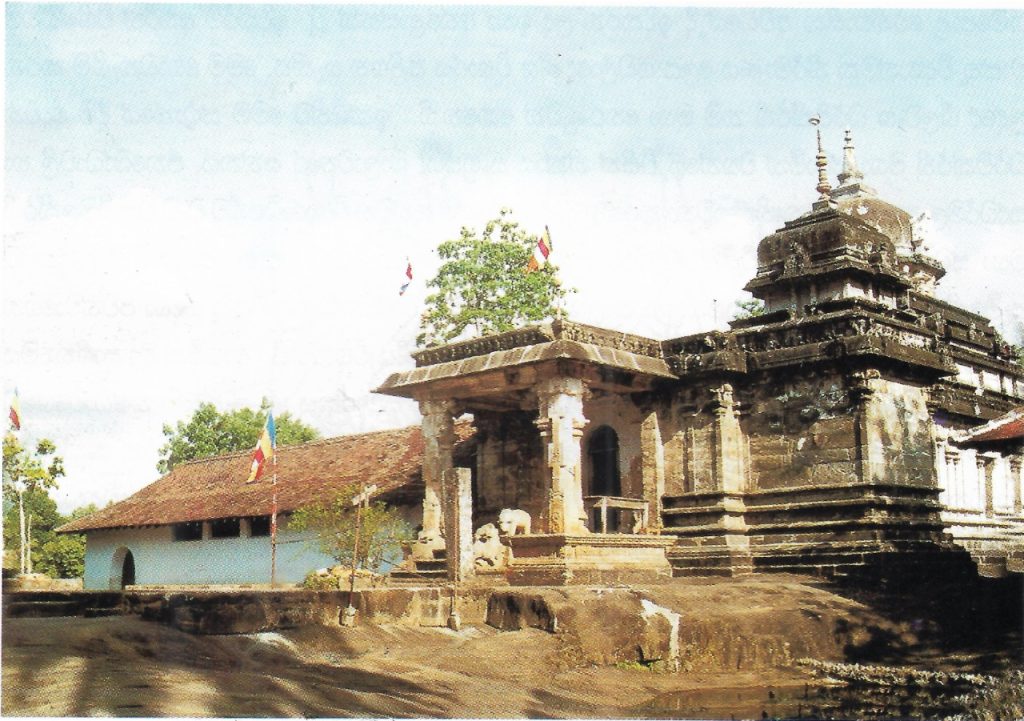
The Gadaladeniya Vihara was constructed in 1344 CE under the guidance of Venerable Dharmakīrti I during the reign of King Bhuvanekabāhu IV. With the generous patronage of the king, the royal family, ministers, government officials, and the collective support of both Sinhalese and Tamil communities, Venerable Dharmakīrti I oversaw the establishment of this remarkable granite shrine on the boundary between Udunuwara and Yatinuwara. Originally designed as a three-storied shrine, the lower-level featured depictions of the Buddha seated on his sacred throne consists of a dragon arch surrounded by celestial beings, accompanied by four standing Buddha statues. The upper level illustrated the Buddha preaching to divine assemblies from Sakra’s rock throne, while also housing a shrine dedicated to a Hindu deity, reflecting the cultural and religious harmony that shaped the temple’s origins. Through the combined efforts of Sri Lankan and South Indian artisans, the Gadaladeniya Vihara emerged as a monument embodying spiritual devotion and artistic excellence.
During the Gampola era in the 14th century, the Gadaladeniya Vihara rose to prominence as one of the most important Buddhist monasteries in the region. It is the only temple in Sri Lanka where four Sangharājas—the supreme patriarchs of the Buddhist monastic community—resided. The temple also served as the centre of the influential Dharmakīrti monastic lineage, which played a significant role in shaping Buddhist scholarship and monastic practices across several kingdoms, including Gampola, Kotte, Sitawaka, and Senkadagala (Kandy). The title of Sangharāja represented the highest echelon of monastic authority and historically held great influence, not only in religious affairs but also in matters of state, as kings frequently sought guidance from the Sangharāja. This elevated the importance of the monastery where the Sangharāja resided, making Gadaladeniya Vihara a centre of national and religious significance.
Throughout its history, the temple enjoyed continuous royal patronage. King Bhuvanekabāhu IV supported its construction, while King Parākramabāhu V undertook renovations of the Vijayotpāya pagoda. Queen Hena Kanda Biso Bandāra, consort of King Vikramabāhu III, granted lands to the temple, further strengthening its resources. Prominent figures such as Senādhilankāra, Devagiri Pratirāja, and King Parākramabāhu VI contributed to the temple’s maintenance and restoration, as noted in the Mahāvaṃsa and Saddharmaratnākaraya. During the Portuguese invasions of the 15th and 16th centuries, the temple suffered considerable damage, including the loss of valuable sacred objects, yet continued to remain a revered spiritual centre. In the later Kandyan era, King Senāsammata Vikramabāhu, Sri Vīra Parākrama Narendrasingha, and King Kīrti Sri Rājasingha undertook several restoration projects. King Narendrasingha entrusted the care of the vihara to Venerable Welivita Sri Saranankara Sangharāja, while King Kīrti Sri Rājasingha made numerous offerings, including the famed golden relic casket. The final king of Sri Lanka, Sri Vikrama Rājasingha, also contributed to the temple’s upkeep under the guidance of Venerable Welivita Saranankara II.
In addition to its religious significance, the Gadaladeniya Vihara has long served as a centre of learning and literary activity. Many renowned works of Sinhala Buddhist literature, including the Janānurāga Caritaya, Pāramī Mahā Sataka, Nikāya Sangrahaya, Saddharmālankaraya, Saddharmaratnākaraya, Jinabodhāvalī, and the celebrated Bālāvatāra Gadaladeni Sannaya, the translation of the Pāli Bālavatāra, were composed by scholars belonging to the Dharmakīrti monastic lineage. In the 18th century, Venerable Welivita Sri Saranankara Sangharāja established the Sri Dharmakīrti Pirivena within the temple premises, offering education to both monks and lay students. This institution became a foundational centre for early modern Buddhist monastic education in Sri Lanka, further cementing Gadaladeniya Vihara’s enduring legacy in the island’s spiritual and intellectual heritage.